
A future where diverse communities and the ecosystems they depend on thrive together, secure against a changing climate.
About the Trust
Grounded in lived realities and designed for practical resilience.
Saraighat Trust is focused on climate-vulnerable communities whose incomes, wellbeing, and adaptive capacity are deeply tied to climate-sensitive systems across Northeast India.
Vision & Mission
Communities that grow with nature.
Saraighat Trust is a registered non-profit based in Assam, formally established on 9 May 2023 under the Indian Registration Act, 1908. We adopt a participatory, nature-aligned, and systems-based approach to sustainable development, rooted in collaboration, inclusion, and local ownership.
Fostering integrated, inclusive collaboration between communities, experts, and institutions to design and implement solutions that build a thriving, resilient future for all.
Who we work with
Tai-Ahom, Adivasi, Mising, Bodo, OBC and forest-fringe communities in the Kaziranga belt.
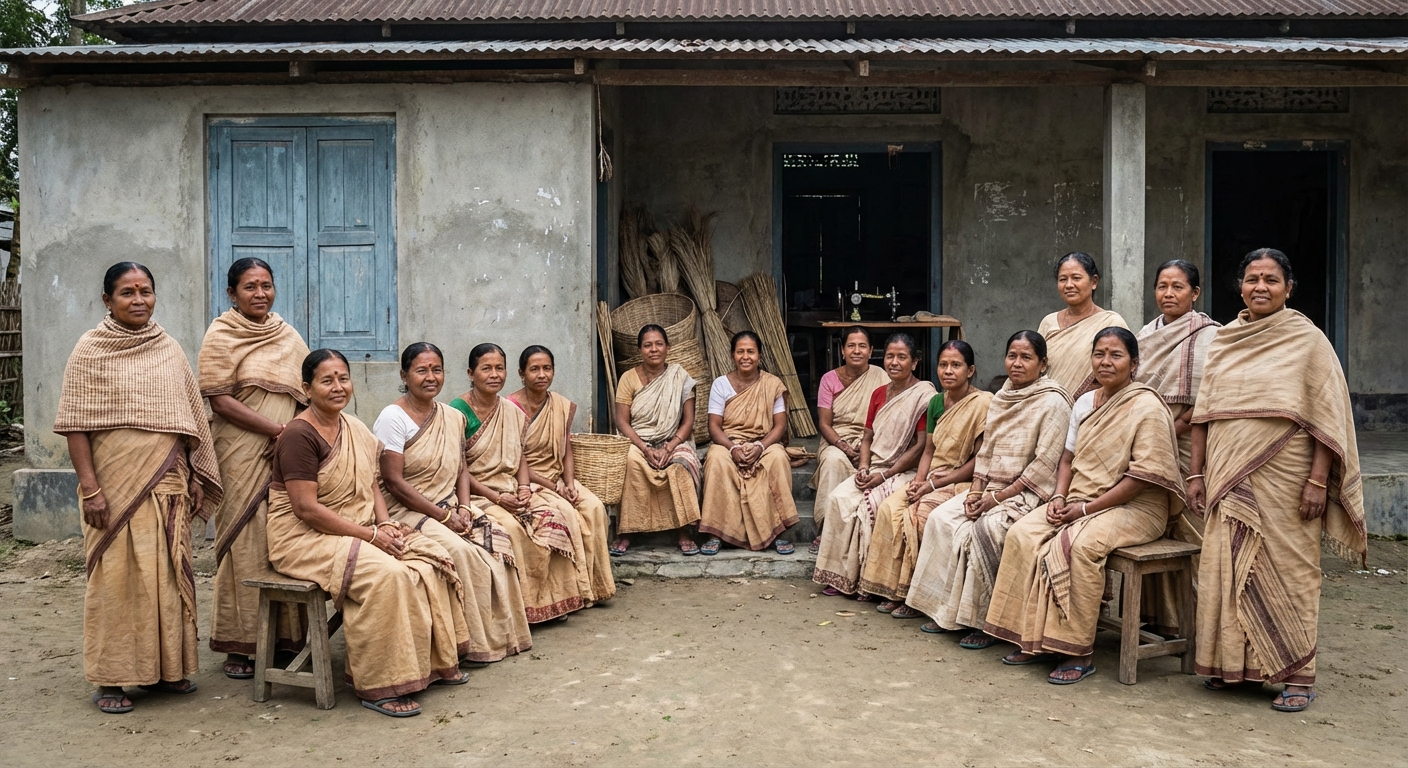
The Trust’s active programmes are shaped by women-led farmer cohorts in the villages of Chepenakubuwa, Borbheta, and Panbaree. These are communities whose livelihoods depend on agriculture, allied activities, local ecosystems, and the fragile rural markets around Kaziranga National Park.
The founding 20-farmer poultry cohort, all women, onboarded in February 2026 with chicks, feed, and three structured trainings on farm setup, maintenance, and disease management.
- OBC and Tai-Ahom community presence in the village
- Local leadership embedded through Plazma Gogoi as Programme Coordinator
A second cohort of 40 women starting training on 25 April 2026, followed by shed construction, advanced rearing and disease management modules, and input support.
A mixed-tribal cluster identified for engagement based on community readiness and overlap with the existing women-led poultry model.
All participating farmers are women. A revolving model funds onboarding of new cohorts from within the same communities: chick costs are repaid as a donation to the Trust, building a self-propagating expansion mechanism.
Why vulnerability deepens
Climate risk compounds what was already unequal.
Exposure is shaped not only by weather or heat, but by savings, access to land and assets, quality of information, local bargaining power, and whether systems respond in time.
When shocks land, households with low reserves experience steeper and longer recovery cycles.
Outdoor labour, agriculture, and river-linked livelihoods carry immediate climate exposure.
Communities most affected often have the least influence over programme implementation and resource flow.
Values
The values that guide the Trust.
These values shape every decision: from programme design and field delivery to reporting, partnerships, and how we communicate with the communities we serve.
Open reporting, honest communication, and clear accountability to the communities, funders, and partners we work with.
Responsible governance and ethical conduct: we do what we say and hold ourselves to it, even when no one is watching.
Rigour and quality in programme design, delivery, and the evidence that guides every decision we make.
Honouring the knowledge, dignity, and lived realities of every community, partner, and colleague we work alongside.
Centring women, youth, and marginalised groups so participation, benefits, and decision-making are fairly shared.