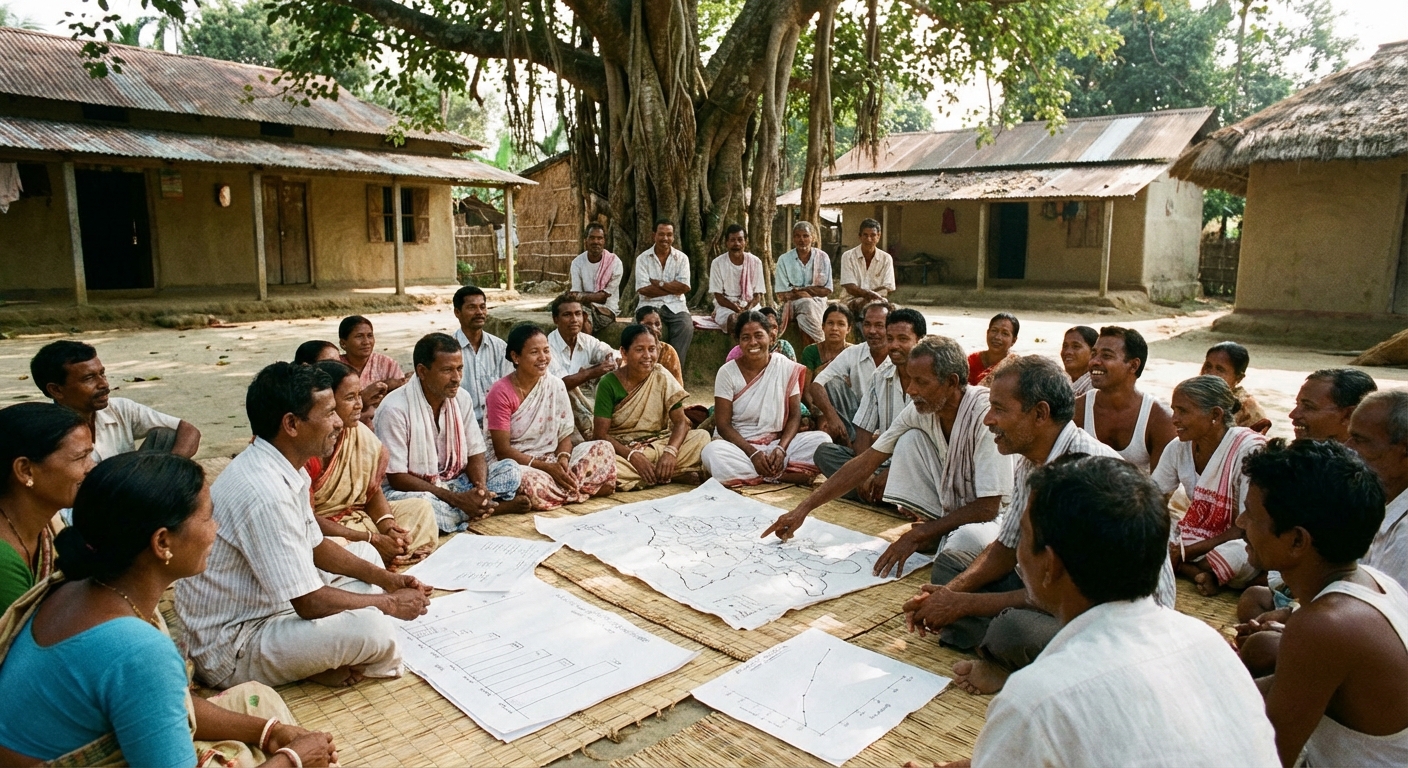
Between climate risk and stable, dignified income. Households need livelihood pathways that are resilient not just for one season, but across years.
Climate adaptation in Northeast India
Building Rooted Resilience with the Saraighat Trust.
We work alongside climate-vulnerable communities across Northeast India to strengthen livelihoods, enable locally led adaptation, and connect field realities to policy and finance.
01
Urgency
Heat, floods, shifting rainfall, and compounding livelihood shocks are intensifying across the region.
02
Approach
Delivery, evidence, and partnerships work as a system rather than as isolated interventions.
03
Intent
Close the gap between climate risk and dignified, resilient livelihoods over the next 3 to 5 years.
Founding stance
An organisation built to bridge widening gaps.
Between local knowledge systems and the new risk environment. Communities hold deep ecological knowledge, but the climate is shifting faster than experience alone can guide.
Between schemes and policies on paper and what is feasible on the ground. Our role is to make adaptation practical, not abstract.
Across two cohorts in Chepenakubuwa and Borbheta in 2026.
Panbaree, Borbheta, and Chepenakubuwa across the Kaziranga belt.
A connected portfolio spanning delivery, evidence, health, scale, and soil.
Mobilised through cash and in-kind contributions, with a built-in revolving model.
The challenge
Why this work is urgent.
Communities across Northeast India are increasingly exposed to climate stresses that interact with health burdens, fragile incomes, weak access to information, and limited bargaining power. Adaptation is a design challenge as much as a delivery one.
Rising temperatures reduce productivity, income security, and physical safety for communities dependent on outdoor labour.
Farming and fishing become more uncertain when seasonal cues are less reliable and local systems lose predictability.
Climate stress interacts with health burdens, debt, and weak access to timely information, so small shocks can quickly escalate.
Institutional responses often struggle to match emerging risk patterns and the lived constraints of households.
Active in the field
A women-led poultry programme in the Kaziranga belt.
In partnership with the Kaziranga National Park and Tiger Reserve authorities, the Trust has onboarded two cohorts in 2026 across the villages of Chepenakubuwa and Borbheta, with a third cluster in Panbaree identified for engagement.
20 Tai-Ahom women farmers received chicks and feed, followed by three structured trainings on farm setup, maintenance, and disease management.
40 Adivasi women begin training, followed by shed construction, advanced rearing and disease modules, and input support.
Farmers repay chick costs as a donation to the Trust, funding new cohorts from within the same communities. This creates a self-propagating expansion mechanism rooted in community ownership.